
Show Notes:
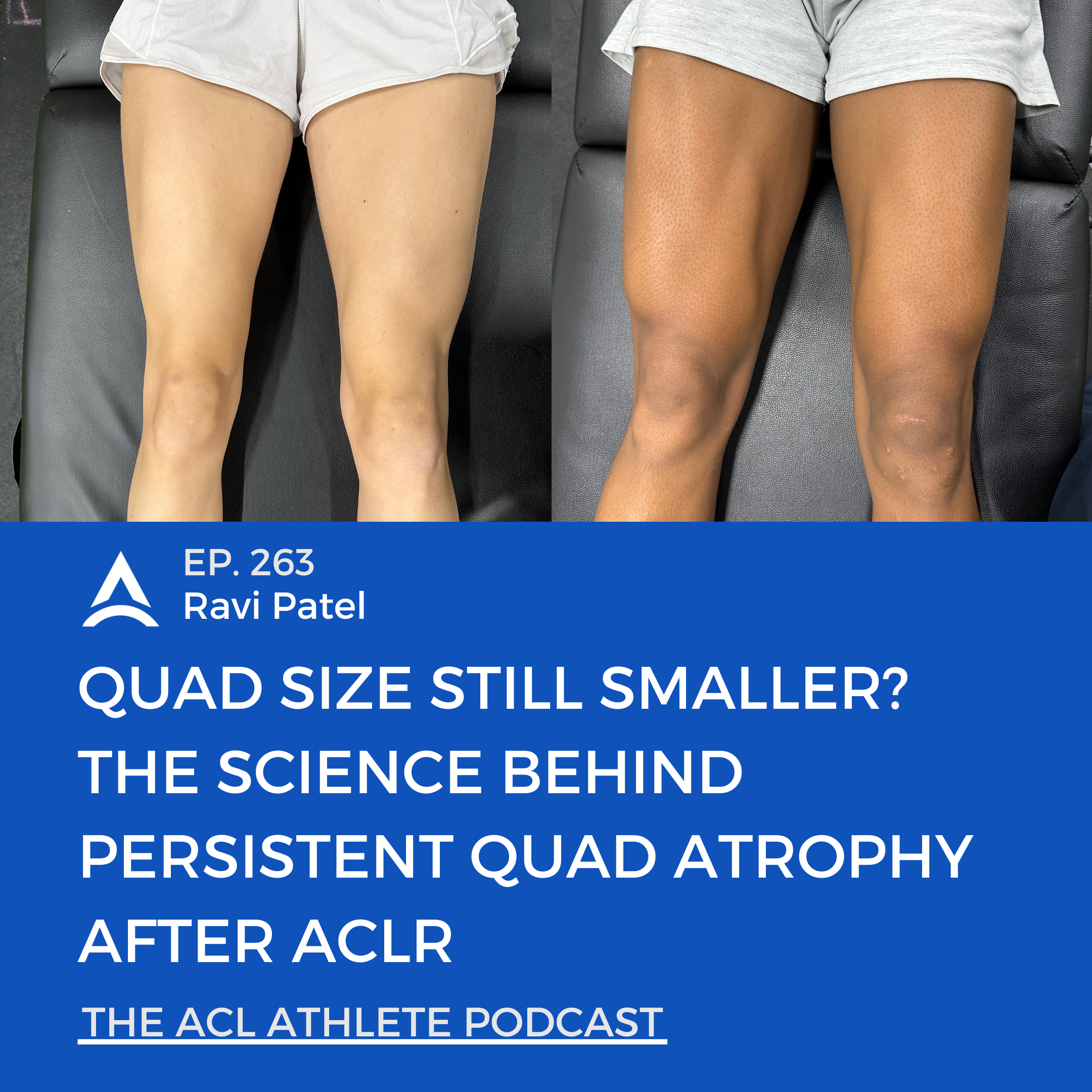
In this episode, we tackle one of the most frustrating and under-discussed parts of ACL rehab: your quad is still smaller months later, and you’re wondering if something is wrong. I break down what the research actually shows about quadriceps muscle mass before surgery, immediately after, and even years down the road. We walk through why atrophy starts earlier than most people realize, why surgery creates a second drop, and why full visual symmetry is not guaranteed within 9–12 months. You’ll also hear real-world examples from elite athletes and why even world-class pros with top-tier resources don’t always regain identical quad size quickly. We unpack graft-type differences, genetics, programming mistakes, and the biological realities that shape muscle recovery. Most importantly, I explain why muscle size and strength are not a perfect one-to-one match using a simple “cup” analogy. Bigger muscles increase potential capacity, but performance depends on more than just volume. If you’ve been staring at your leg, wondering why it still looks different, this episode gives you clarity, normalization, and practical direction on how to approach hypertrophy the right way.
What is up team? And welcome back to the ACL Athlete Podcast. Today, we are talking about something a lot of ACLers think about, but that is not discussed enough in ACL rehab. You hear about strength all the time, but muscle mass itself is rarely emphasized. Many of you are months into the process, and your quad is still smaller. Maybe you are nine, 12, or even 18 months out and looking at your legs, wondering why they do not match. The first thing to understand is that this is normal, more normal than you think.
There is research showing that people do not always regain 100% side-to-side symmetry in quad size. You may see highlight videos of athletes flexing quads that look identical, and those comeback stories are real. Some athletes absolutely regain full quad size, and we have seen that happen. However, there are also many people who do not fully regain size within nine to 12 months, or even within the first two years, unless they are highly focused on quad hypertrophy. Genetics and graft type also influence how much size comes back. These variables matter more than most ACLers realize.
Quad atrophy actually starts before surgery. After an ACL injury, you can look down a day or two later and feel like your quad disappeared. The muscle you worked so hard to build suddenly looks dramatically smaller. Research supports this experience. A 2024 quantitative MRI study by Anderson et al. showed that even before ACL reconstruction, the ACL-deficient limb had reduced quadriceps physiological cross-sectional area compared to the uninvolved limb.
This means the quad is already smaller before surgery takes place. That context is critical. If you imagine your quad size and fitness level as standing on the 10th floor, the ACL injury may drop you to the sixth or seventh floor. If you skip meaningful prehab and rush into surgery, you may stay there or drop further. Then surgery can knock you down again, perhaps to the third floor, making the climb back to the 10th floor much longer and harder.
Surgery itself accelerates muscle loss. An ultrasound study by Williams et al. in 2020 measured quad thickness one hour before surgery and again 48 to 72 hours after ACL reconstruction. They found a significant decrease in vastus intermedius thickness within days. That feeling of your quad disappearing right after surgery is backed by physiology. This is why early activation and day-one rehab matter so much in ACL rehab.
Even at return to activity, the quad size often has not fully recovered. An ultrasound study by Thomas in 2020 tracked the quad cross-sectional area pre-op, nine weeks post-op, and at clearance. The uninvolved limb returned to pre-op size, but the involved limb did not. This means ACLers may be cleared for activity while quad size still lags behind. Clearance does not guarantee full muscle symmetry.
MRI-based research summarized by Lepley in 2015 showed approximately a 7% quadriceps volume deficit at six to 12 months post-ACLR. While 93% symmetry may not sound dramatic, it can still be visually noticeable. Deficits were still present at 12 to 18 months, though reduced. Persistent asymmetry has even been documented years later. An ultrasound study by Kuenze in 2020 found vastus lateralis cross-sectional area deficits around 50 months post-ACLR.
There is also a subgroup of ACLers who trend toward persistent quad size differences. [Wilsan] in 2022 identified an atrophy cluster with marked vastus medialis and vastus lateralis asymmetry even in later stages. An MRI study in 2025 by Greenwood et al. examined Division I football athletes about 28 months post-ACLR and found persistent volume deficits. Even elite athletes with significant resources do not always regain identical quad volumes. This normalizes the experience for everyday ACLers.
Real-world examples show similar patterns. Athletes like Alfonso Davies and Saquon Barkley have shown visible quad asymmetry during their return phases. Even with high resources, full symmetry is not guaranteed. Professional-level care does not automatically mean perfect outcomes. Quad asymmetry is common, even at the highest levels.
Not everyone regains full quad size quickly, and some take longer than nine to 12 months. Factors influencing recovery include injury severity, swelling duration, arthrogenic muscle inhibition (AMI), programming quality, protein intake, sleep, genetics, training age, limb dominance, psychological loading tolerance, and graft type. Quad tendon grafts often present with more visible and sometimes longer-lasting quad atrophy because tissue is harvested directly from the extensor mechanism. Patella tendon grafts also challenge anterior knee structures, while hamstring grafts spare the quad but may weaken the posterior chain. Each graft type carries trade-offs.
Now the practical question: what should ACLers do? First, understand that quad size recovery takes time. A smaller quad within the first nine to 12 months is expected. Strength and muscle size are related but not identical. Think of muscle size as the size of a cup and strength as how much water that cup can hold. A larger cup has greater potential capacity, but two slightly different cups can still be filled to the top. Muscle hypertrophy increases potential force capacity, yet neural efficiency, tendon adaptations, coordination, genetics, and rate coding also influence strength. Muscle size and strength are not in a one-to-one relationship. ACLers can regain high levels of strength even if visual symmetry is not perfect.
That said, hypertrophy matters. A minimum of about 10 hard sets per muscle group per week is a practical target, often spread across two to three sessions. Advanced lifters may benefit from 12 to 20 sets, with diminishing returns beyond that. The key variable is proximity to failure, typically leaving one to two reps in reserve. Effort drives adaptation.
Both heavy compound lifts and moderate to lighter isolation work are valuable. Heavier loads in lower rep ranges can support strength, while moderate to higher reps near failure support hypertrophy. Isolation movements such as knee extensions are critical because they directly target the quadriceps. The leg extension machine is the only true isolation movement for the quads, and research does not support blanket avoidance when programmed appropriately.
Lengthened position loading may also enhance hypertrophy. Adjusting the seated knee extension setup to increase quad length can improve stimulus. Stretch-mediated hypertrophy is an emerging area of research that supports this approach. Strategic programming minimizes joint stress while maximizing muscle stimulus.
Blood flow restriction (BFR) training is another useful tool in ACL rehab. BFR allows ACLers to create meaningful muscle stimulus at lower loads, which can reduce joint irritation. For quad graft athletes in particular, BFR can support hypertrophy without excessive stress on healing tissues. The goal is to train the muscle without aggravating the joint.
It is important not to tie self-worth or progress entirely to visual symmetry. Many ACLers at nine to 12 months still demonstrate quadriceps asymmetry. It may take longer than a year for full visual recovery, and some individuals may always have subtle differences. Performance often returns before perfect aesthetics.
Quad atrophy after ACLR is common, persistent within the first year, and sometimes presents years later. This does not mean you are broken or behind. The body has gone through trauma, surgery, inhibition, and altered loading. The rebuilding process is not linear.
Chase strength, capacity, resilience, and hypertrophy intelligently. Use sound programming and appropriate loading. Understand that muscle mass recovery takes weeks and months of consistent effort. The human body is adaptive, and progress is possible even if perfect symmetry is not immediate.
If you are staring at your leg in the mirror, wondering why it does not look the same, know that you are not alone. ACLers across levels experience this. Keep building. Performance can return before aesthetics do. This is Ravi Patel signing off.
Subscribe and leave The ACL Podcast a review – this helps us spread the word and continue to reach more ACLers, healthcare professionals, and more. The goal is to redefine ACL rehab and elevate the standard of care.
Resources:
- Check out our free ebooks on our Resources page
- Sign up for The ACL Athlete – VALUE Newsletter – an exclusive newsletter packed with value – ACL advice, go-to exercises, ACL research reviews, athlete wins, frameworks we use, mindset coaching, blog articles, podcast episodes, and pre-launch access to some exciting projects we have lined up
- 1-on-1 Remote ACL Coaching – Objective testing. An individualized game plan. Endless support and guidance. From anywhere in the world.
- More podcasts? Check out our archives
Connect:
- Have questions or a podcast idea? Send us a message