
Show Notes:
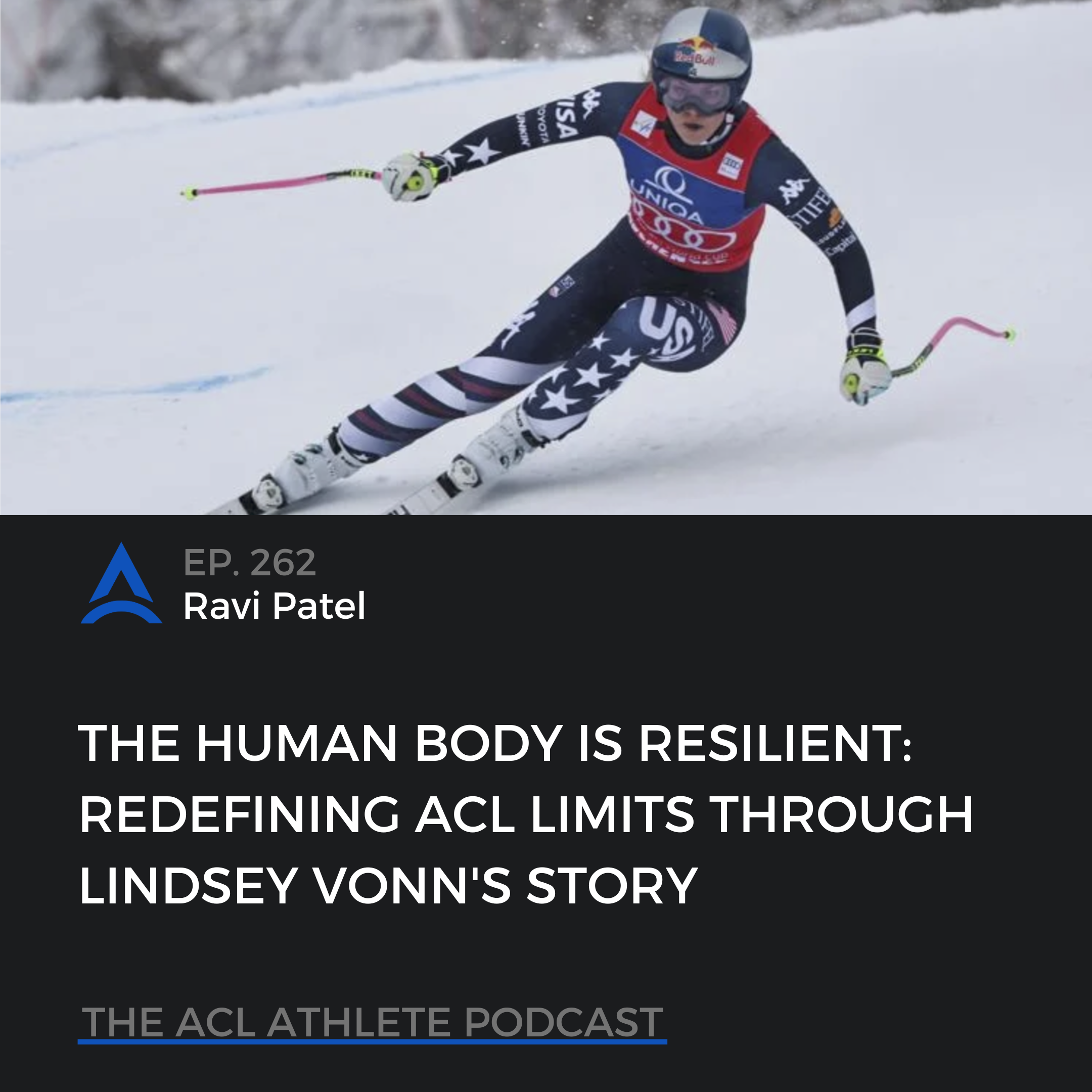
In this episode, we take a deeper, more grounded look at resilience through the lens of Lindsey Vonn’s ACL journey. Not as motivation, but as a real, physical, and mental demonstration of what the human body is capable of when given time, intention, and the right environment. From multiple ACL tears and degenerative knee changes to a partial knee replacement and a late-career Olympic push, Lindsey’s story challenges rigid narratives around timelines, imaging, and “what should be possible” after injury. This episode unpacks the difference between structure and function, why feeling good doesn’t always mean being ready, and how capacity, tolerance, and informed decision-making matter far more than labels. Most importantly, it reframes the ACL journey with a powerful reminder: it’s never too late to rebuild, adapt, and return to what matters to you.
Links:
- https://www.instagram.com/p/DUI-ajQDTCc/
- https://www.espn.com/olympics/skiing/story/_/id/47776769/vonn-crashes-limps-final-test-run-week-olympics
- https://www.instagram.com/p/DUTSTCvDdIp/
- https://www.espn.com/olympics/story/_/id/47816576/vonn-confident-race-olympics-ruptured-acl
- https://www.instagram.com/reel/DUTcSDGEfPn/
What is up team? And welcome back to another episode on the ACL Athlete Podcast. Today, I’m going to take a little bit of a different spin on an episode, and I’m excited to dive into it. Resilience is often discussed as a mindset, but in the world of ACL injuries, it is also deeply physical. The human body has an extraordinary capacity to adapt, recover, and perform under conditions that challenge conventional assumptions. Few stories illustrate this more powerfully than that of Lindsey Vonn. Her journey is not presented as a blueprint for decision-making after ACL injury, nor as a recommendation to imitate elite-level risk-taking. Instead, it serves as a compelling case study that forces ACLers to reconsider how limited we often believe the body to be after serious injury.
Lindsey Vonn’s relevance to the ACL community extends beyond her fame. As one of the most decorated alpine skiers in history, her career unfolded in a sport that places extreme mechanical demands on the knees. Speed events in downhill skiing generate immense forces, and Vonn endured those stresses for years at the highest level. Her story resonates deeply with ACLers because it confronts the fear that multiple injuries, surgeries, or setbacks permanently define what the knee can do. At a time when her return has dominated headlines, her experience offers a timely and grounded reflection on resilience rather than superficial inspiration.
When examined closely, Vonn’s career challenges some of the most rigid narratives surrounding ACL injuries. Multiple ACL tears do not automatically signal the end of an athletic career. A knee replacement does not inherently eliminate the possibility of high-level loading or demanding activity. Structural damage does not always correlate directly with functional capacity, and chronological age does not perfectly predict biological performance. Many ACLers have seen similar truths in their own lives, particularly those who return to endurance sports, skiing, or consistent training well beyond what they were told was realistic.
This distinction is critical: Vonn’s story is not about ignoring injury or denying medical reality. It is about understanding how the body adapts when given adequate time, intention, and an appropriate environment. To appreciate this fully, it is important to understand the context of her journey. Lindsey Vonn became one of the greatest downhill skiers of all time, achieving 82 World Cup wins and Olympic gold medals in events known for punishing knee stress. In 2013, a severe crash resulted in tears to her ACL and MCL, marking the beginning of a long and difficult chapter in her career.
What followed was not a smooth recovery arc. Vonn experienced multiple ACL tears, revision surgeries, meniscus and cartilage damage, and years of managing persistent pain. Over time, degenerative changes in her knee became increasingly limiting. In 2019, she retired from competition, not because she lost the ability to ski, but because her knee could no longer tolerate the demands she placed on it. Her drive remained intact, yet her joint capacity had become the primary constraint.
In 2022, Vonn underwent a partial knee replacement, a procedure often misunderstood outside clinical settings. Unlike a total knee replacement, a partial replacement addresses specific compartments affected by arthritis or cartilage loss. The primary goal was quality of life rather than a competitive comeback. However, this intervention marked a turning point. Between 2023 and 2025, Vonn returned to training, skiing, and rebuilding her physical capacity. By 2026, she had set her sights on Olympic competition once again, challenging deeply ingrained assumptions about what is possible after major injury and surgery.
Her return alone would have been remarkable, but the story intensified further. Just one week before the Olympics, Vonn sustained another crash, tearing the ACL in her opposite knee. Initial uncertainty followed, as it does for most ACLers, with consultations, imaging, and evaluation guiding the next steps. Rather than making a reactive decision, she engaged her medical team, underwent therapy, completed physical testing, and returned to skiing. Shortly thereafter, she announced that she was capable of competing in the Olympic downhill event.
Clinically, her knee presented with significant findings: a complete ACL tear, bone bruising, and meniscus damage in the opposite one that had already undergone partial replacement. Functionally, however, her assessment told a different story. She reported knee stability, absence of swelling, appropriate muscular activation, and the ability to tolerate the specific demands of skiing. This distinction highlights a core principle often misunderstood in ACL conversations. Structure is only one component of the equation; capacity and tolerance determine function.
Vonn’s decision was not rooted in denial or recklessness. She acknowledged the risks, including the potential need for further surgery and accelerated degenerative changes. What made her choice deliberate was clarity. She understood the trade-offs and accepted them in pursuit of something deeply meaningful. For her, returning to sport was not a binary outcome but a nuanced decision aligned with her values, identity, and legacy. This same framework applies to ACLers making decisions at every level, from elite competition to recreational sport.
It is important to emphasize that this scenario does not apply universally. Most ACLers should not interpret this as encouragement to compete immediately after injury. However, the underlying principles remain relevant. Returning to sport is rarely a simple yes-or-no question. It is a risk–reward calculation informed by preparation, context, and personal priorities. Lindsey Vonn represents an extreme end of this spectrum, shaped by decades of training, exposure, and experience.
For ACLers listening from any stage of recovery—weeks, months, or even decades out—the broader message is powerful. It is never too late to rebuild capacity. One of the most persistent myths surrounding ACL injuries is that missed opportunities early in rehabilitation permanently limit future potential. While time does influence joint health, it does not eliminate the body’s ability to adapt. With the right plan, progression, and guidance, many individuals regain confidence, tolerance, and performance years after their initial injury.
This adaptability is not theoretical. ACLers who lacked appropriate rehabilitation earlier in life often discover that structured, intentional training allows them to run, cut, play sports, and trust their knee again. The human body remains remarkably responsive when given the correct stimulus. Stories like Vonn’s challenge the belief that decline is inevitable and reinforce the importance of maintaining an open mindset toward what recovery can look like.
Vonn herself articulated this perspective succinctly in a recent interview, emphasizing belief, effort, and openness to possibility. She noted that age is not the defining factor, but rather the willingness to work hard and remain receptive to opportunity. This mindset does not replace medical guidance or sound decision-making, but it profoundly influences outcomes. Mindset shapes action, and action determines progress.
Ultimately, this story is not about defying injury but redefining limits. It underscores that timelines, imaging, and past setbacks do not have to dictate the future for ACLers. With appropriate support, clarity, and consistency, meaningful progress remains possible. Lindsey Vonn’s journey matters not because it should be replicated, but because it expands the conversation around what the human body can do when resilience meets informed decision-making.
Until next time, this is your host, Ravi Patel, signing off.
Subscribe and leave The ACL Podcast a review – this helps us spread the word and continue to reach more ACLers, healthcare professionals, and more. The goal is to redefine ACL rehab and elevate the standard of care.
Resources:
- Check out our free ebooks on our Resources page
- Sign up for The ACL Athlete – VALUE Newsletter – an exclusive newsletter packed with value – ACL advice, go-to exercises, ACL research reviews, athlete wins, frameworks we use, mindset coaching, blog articles, podcast episodes, and pre-launch access to some exciting projects we have lined up
- 1-on-1 Remote ACL Coaching – Objective testing. An individualized game plan. Endless support and guidance. From anywhere in the world.
- More podcasts? Check out our archives
Connect:
- Have questions or a podcast idea? Send us a message